


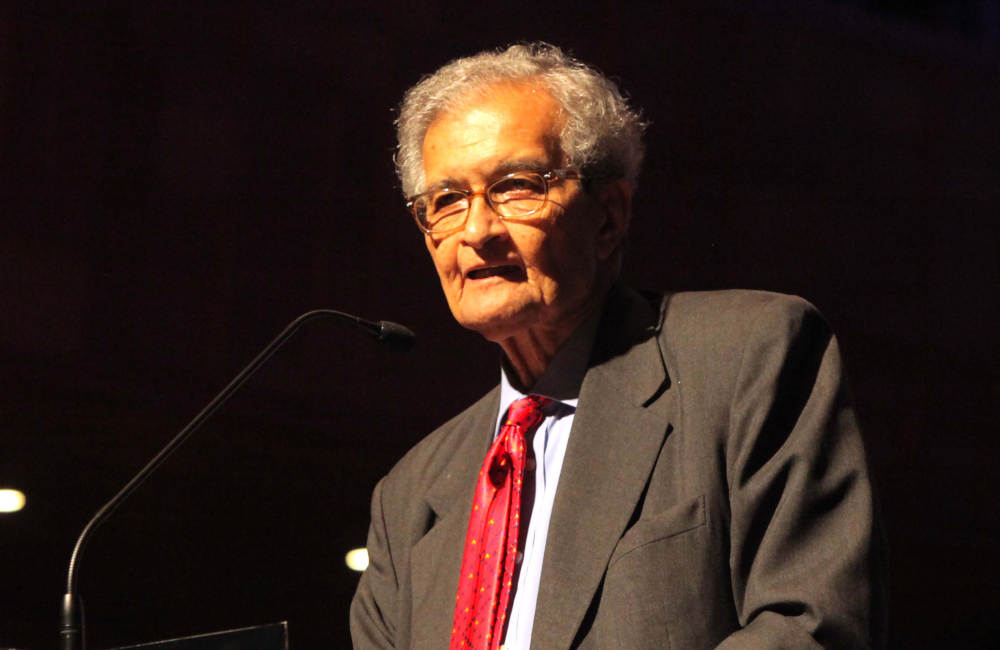
The economist who taught the world to measure a good life by freedom, not just income.
A nine-year-old watched the 1943 Bengal famine. Decades later, he showed that famines are rarely about missing food.
Most of us measure success by what we own. Amartya Sen asked a harder question: what are people actually free to do and be? This profile follows his life and big ideas, where critics push back, and how an ordinary person can use his thinking in family, money and service.
Amartya Sen is living, so this is a biography to date rather than one from birth to death. He was born on 3 November 1933 and turns 93 next month.
Brief life history
Amartya Kumar Sen was born in Santiniketan, Bengal, the school town built around Rabindranath Tagore. His father taught chemistry in Dhaka, where Sen began his schooling.
Three early experiences shaped his work:
- The 1943 Bengal famine. At nine he saw millions die while grain still existed.
- Communal violence in the 1940s. He saw a Muslim day-labourer killed after entering a hostile neighbourhood to find work, driven by poverty. It taught him how deadly narrow identities and economic desperation can be together.
- Cancer at 18. He survived oral cancer after radiotherapy, which he later linked to a deep sympathy for the vulnerable.
He studied at Presidency College, Kolkata, then at Trinity College, Cambridge, earning his PhD in 1959. He held professorships in Kolkata and Delhi, then at LSE, Oxford and Harvard. He was Master of Trinity College, Cambridge (1998 to 2004) before returning to Harvard. He has been married three times, most recently to Emma Rothschild, and has four children.
Major contributions and achievements
Sen won the 1998 Nobel Prize in Economics for his contributions to welfare economics, and his ideas reshaped how the world measures poverty and progress.
- Social choice theory: how to combine individual preferences into fair collective decisions, including his “liberal paradox” (1970).
- Entitlement theory of famine (Poverty and Famines, 1981): famines are usually caused by people losing the means to command food, not simply by a lack of food. He argued that functioning democracies with a free press rarely suffer famine.
The capability approach: wellbeing means what people are actually able to do and be. - Human Development Index: he helped Mahbub ul Haq build it (1990) to measure progress beyond GDP.
- “Missing women” (1990): he drew attention to the huge shortfall of women caused by gender discrimination.
- Major books: Development as Freedom, The Argumentative Indian, Identity and Violence, The Idea of Justice and the memoir Home in the World.
- Honours: the Nobel Prize (1998), the Bharat Ratna (1999) and the Peace Prize of the German Book Trade (2020).
Public service: he put his Nobel money into the Pratichi Trust, which studies and improves schooling and health in India and Bangladesh.
The enduring principle
Development is the expansion of real freedom: the substantive ability of people to live lives they have reason to value. A society or a life should be judged by what people can actually do and be, not just by the income or resources they hold.
Two corollaries follow:
- Choice matters morally. A person who fasts and a person who starves have the same body but very different freedom.
- Public reasoning is part of freedom. Open debate, a free press and democratic voice are both a means to progress and a part of it.
1. Weaknesses, contradictions and unintended consequences
Sen’s ideas are powerful as a lens but harder to turn into rules, and several have been contested or misused.
- Vagueness. Sen refused to fix a list of core capabilities, unlike his collaborator Martha Nussbaum. Critics say the approach is hard to turn into a testable theory or a clear policy rule.
- Measurement compromise. He doubted that one number could capture human life, yet he helped create the HDI. It is simple and widely used, but it is crude and correlates strongly with income.
- Contested famine evidence. Some historians argue that real food shortages mattered more in the Bengal famine than his thesis allows. Democracy also prevents famine but not chronic undernutrition, which India has struggled with.
- No blueprint. The Idea of Justice favours reducing clear injustices over defining a perfect society. Admirers find this realistic, while critics say it gives too little guidance on priorities.
- Growth versus welfare debate. Economists such as Jagdish Bhagwati and Arvind Panagariya argued that he underplayed growth as the engine that funds social spending. Sen’s reply is that both are needed.
- Unintended consequences. Capability language was adopted by institutions and can turn into box-ticking dashboards. Country rankings can also push governments to chase the indicator instead of the underlying freedom.
- Political and institutional controversies. His sharp criticism of India’s current government drew accusations of partisanship. He also left the chancellorship of Nalanda University in 2015 amid a dispute over government interference, and had a land dispute with Visva-Bharati University that he rejected.
2. How an ordinary person can apply the lessons
The core habit is to ask what people can actually do and be, then widen those real options.
Personal life
- Ask “what can I actually do and be?” before “what do I have?” Audit your real options in health, skills, time and choice.
- The same money gives different freedom to different people. Don’t judge yourself or others by income alone.
- You hold many identities (parent, professional, citizen), so don’t let one define you.
Relationships
- With teenagers, widen their capacity to choose through education, information and reasoned dialogue, instead of only deciding for them.
- Ask whether the person had a real choice before judging an outcome.
- Argue with reasons and welcome dissent. Sen’s “argumentative” tradition is about disagreeing without contempt.
- Don’t wait for a perfect arrangement. Fix the most obvious unfairness first.
Financial decisions
- Treat money as a means. Ask what it converts into: security, time, health, options.
- Use a dashboard instead of one metric: income stability, emergency buffer, debt, insurance, skills and net worth. This is the HDI lesson.
- Famine logic applies to households too. Shocks hurt those with the thinnest buffers, so build liquidity and skills before you need them.
Public service
- Go to the ground and listen first, as the Pratichi Trust did, then act on what the data and the people tell you.
- Use your voice: vote, ask for information, support a free press and local accountability.
- Target concrete, measurable deprivations like absent teachers, unaffordable care or missing documents, instead of waiting for a grand solution.
Sen’s lasting gift is a question, not a formula: what can the people in my care actually do and be, and what would widen it? Admire the ideas, weigh the critics, then take one small step this week. Pick one real constraint, such as a teenager short of information, a thin emergency buffer or a failing local service, and widen it.